We're Bringing Back Mothers' Night
Last December, on the night before Christmas, my partner and I realised something.
Somewhere in the Christmas Eve rush of wrapping, cooking, carol playlists, and last-minute dashes to the shops, an ancient festival had slipped completely out of sight. Hardly anyone seemed to mark Mothers' Night any more.
So we decided to make it a thing again.
What is Mothers' Night?
More than 1,300 years ago, the English kept a midwinter festival called Modraniht, the Night of the Mothers. We only know about it thanks to a single sentence written by the monk Bede in AD 725. He tells us that the pagan English began their year on the night we now call Christmas Eve, and that they stayed awake all night in honour of the mothers. Then he moves straight on to calculating the date of Easter, and the details are lost.
Who those mothers were, we can only guess. Roman altars across the Rhineland and Britain honoured groups of mother goddesses, almost always shown in threes. Later Norse feasts raised toasts to ancestors who had died. Mothers' Night may have been a little of both: a long winter's night for the divine mothers and for the mothers of our own families.
The full story, with all the sources, is on ramapani.com: Mothers' Night: Modraniht, the Ancient Night of the Mothers
Why Bring it Back?
Because it's a beautiful idea that deserves a second life. At the darkest point of the year, our ancestors gave a whole night to the mothers. We think that's worth doing again.
It also fits easily into modern life. Mothers' Night sits right beside Christmas, so families of any belief, or none at all, can keep it together. Heathens and pagans can mark it as the opening of Yule. Everyone else can simply light a candle on Christmas Eve and remember the women who raised them.
There's only one rule: we gather. In person or online, a crowd or a handful. Who we honour is up to us: our mums, our grandmothers, our ancestors, the divine feminine, or everyone who ever mothered us. We can light candles, raise a toast, read a passage, share a meal, or throw a party that runs until dawn.
A Free Guide to Getting Started
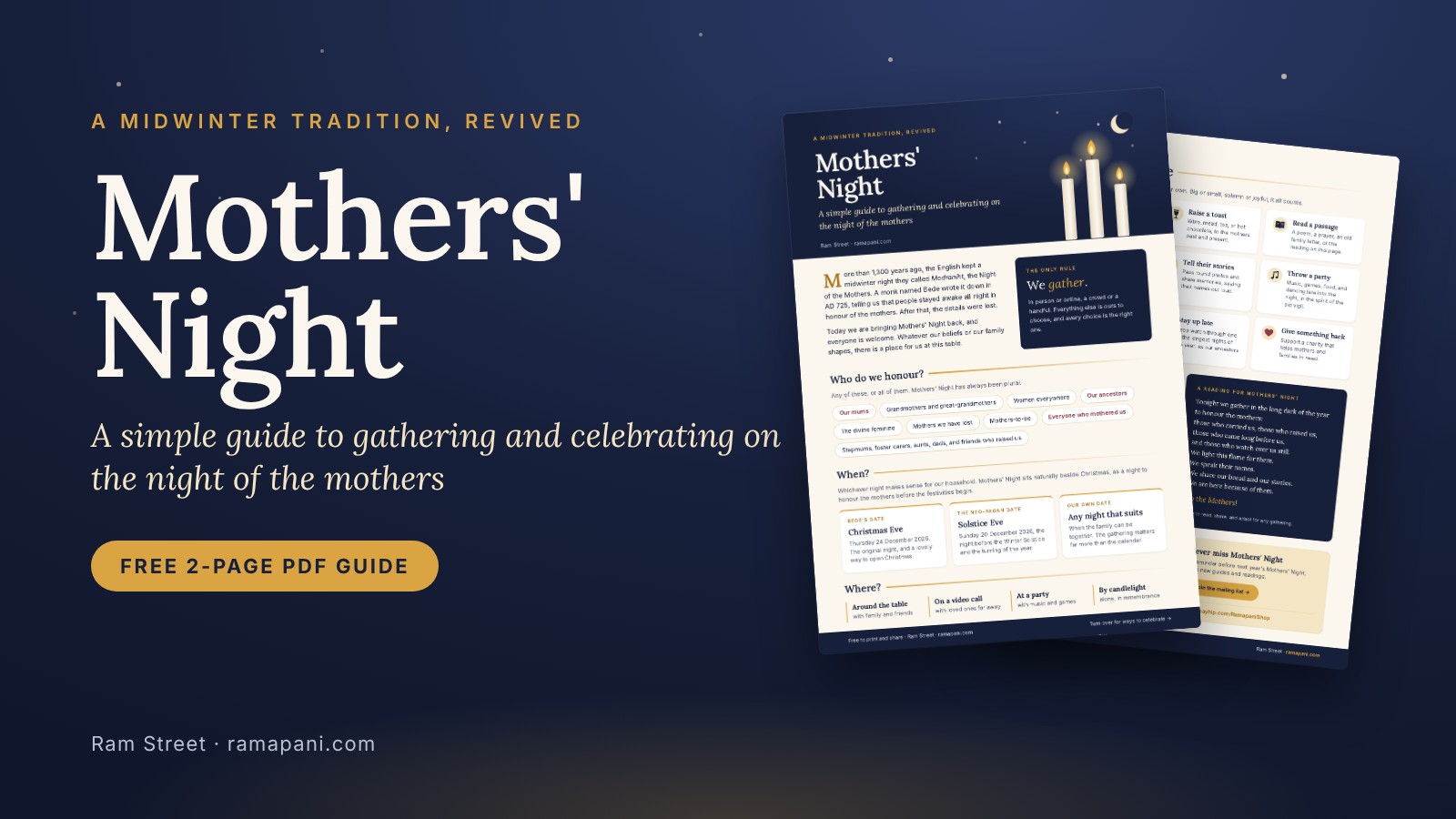
To make it easy, we've put together a free two-page guide with everything needed for a first Mothers' Night: who to honour, when and where to gather, nine ways to celebrate, a simple step-by-step celebration, and an original reading to share aloud.
Download it free: https://tinyurl.com/Modraniht
This year, Mothers' Night falls on Sunday 20 December (the eve of the Winter Solstice) or Thursday 24 December (Christmas Eve, Bede's original date). Any night that suits the family works just as well.
Helping to Bring it Back
Reviving a 1,300-year-old festival turns out to be easy:
- Download the guide and share it with family and friends.
- Light a candle for the mothers this December.
- Post a photo with #MothersNight so we can all watch the revival spread.
- Join our mailing list for a reminder before next year's Mothers' Night: Join the Mailing List
And if this kind of work brings a little light into the winter, a coffee here helps keep the guides free for everyone.
Here's to the mothers. 🕯️
Ram, , Southwold


 Support me on Patreon



 Subscribe without emails | RSS Feed
